
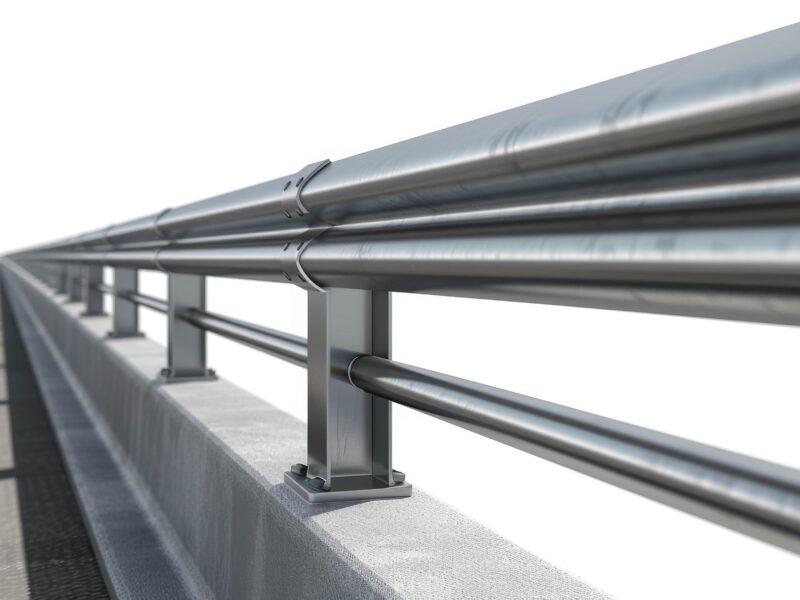
India’s roads are among the busiest and most diverse in the world, stretching from high-speed expressways to winding mountain passes. In such a landscape, crash barriers (guardrails) serve as a vital line of defense.
They protect lives by absorbing impact, preventing vehicles from veering off-road, and reducing accident severity. Yet despite their proven utility, guardrail failures remain alarmingly common, often due to issues that occur not in design, but in installation.
This blog explores why guardrails fail, highlighting installation mistakes, their consequences, and best practices government stakeholders must follow to ensure infrastructure that truly protects.
What Are Guardrails and Why Are They Essential?
Guardrails (or crash barriers) are safety systems installed along roads, highways, bridges, and dangerous curves to:
- Contain and redirect vehicles during collisions
- Prevent crashes from escalating into fatal incidents
- Minimize property damage and vehicle loss
- Improve visual continuity and driver perception of road alignment
Common Types of Guardrails Used in India:
- W-Beam Crash Barriers: Most widely used, made from galvanized steel
- Thrie-Beam Barriers: Offer greater impact resistance; ideal for high-speed zones
- Wire Rope Safety Barriers (WRSB): Flexible design suited for medians
- Concrete Barriers: Strong and durable; used in urban or sensitive areas
Despite their variety, all guardrails must meet IRC and MoRTH specifications to be considered safe for deployment.
👉 Learn more about SKYK’s crash barrier solutions
Top 7 Mistakes That Cause Guardrail Failures
Let’s explore the most common errors in crash barrier installations observed across Indian infrastructure projects:
1. Incorrect Guardrail Height
A small height misalignment can drastically reduce the effectiveness of a guardrail.
- Too low: Cars can vault over the barrier.
- Too high: Smaller vehicles may go under.
- Fails to meet IRC recommendations (typically 700 mm ± 20 mm from road surface)
Causes:
- Uneven road surface
- Installation without proper leveling tools
- Overlooking terrain variations
2. Improper Post Spacing or Shallow Embedment
Support posts form the backbone of a barrier system. Improper spacing or weak foundations can lead to barrier collapse during impact.
- Posts too far apart weaken structural integrity
- Shallow embedment results in bending or uprooting
- Ignoring soil conditions during planning
Impact:
- Barrier fails to absorb or redirect impact
- Reduced energy dissipation during collisions
3. Faulty or Unanchored Terminal Ends
Terminal ends—start and end points of guardrails—must be energy-absorbing and anchored.
Common Issues:
- Missing terminals
- Non-energy-absorbing end caps
- Poor anchoring in soft or eroding soil
Without a proper terminal, vehicles may crash into sharp edges or get impaled by barrier ends—leading to fatal outcomes.
4. Substandard or Non-Certified Materials
Many failures can be traced to inferior material quality—especially in rural or cost-sensitive projects.
Examples:
- Low-grade steel prone to rust
- Bolts and fasteners that shear under pressure
- Locally fabricated parts that lack load-bearing certification
Warning Sign:
- If it’s not certified under MASH or IRC, it shouldn’t be on the road.
5. One-Size-Fits-All Installation
Guardrails need to be site-specific, but many installations follow a blanket approach.
Key Variations Ignored:
- Traffic volume
- Terrain slope
- Vehicle type (commercial vs. passenger)
- Road width and curvature
Installing the same barrier across plains, hills, and highways without adaptation is a recipe for disaster.
6. Lack of Skilled Installation Teams
Crash barrier performance heavily depends on installation accuracy, but this stage is often overlooked or subcontracted with minimal supervision.
Common Workmanship Errors:
- Uneven railing height
- Misaligned posts and bolts
- Loose fasteners due to manual tightening
- Improper overlap direction
Untrained crews may complete installations that look fine—but fail during impact.
7. Ignoring Maintenance and Post-Impact Repair
Even the best-installed barriers degrade over time or get damaged in minor collisions.
Typical Oversights:
- Rusted or missing bolts left unreplaced
- Bent posts not straightened
- Missing sections not reinstalled
- No routine inspection schedule
A damaged barrier is as good as no barrier. Maintenance must be scheduled and enforced.
Key Standards for Crash Barrier Installations in India
For public infrastructure, compliance with national and international standards is mandatory. Here are the primary guidelines:
1. IRC (Indian Roads Congress)
- IRC SP 87: Guidelines for the Design and Installation of Crash Barriers
- IRC 119: Standard Specifications and Code of Practice
2. MoRTH (Ministry of Road Transport & Highways)
- Defines material specs, layout norms, and testing procedures
3. Crash Testing Norms
While India is still transitioning toward full compliance, reference is made to:
- MASH (Manual for Assessing Safety Hardware) – USA standard
- EN 1317 – European standard
Procurement should mandate certifications and suppliers must meet crash-test validation.
How to Prevent Guardrail Failures in Public Road Infrastructure Projects
Strong road safety starts with process discipline. Here’s what public works authorities, highway agencies, and project managers should implement.
Pre-Installation Planning
- Conduct site surveys for terrain, traffic, and environment
- Select barrier types based on vehicle mix and speed
- Account for soil strength in foundation design
Use Certified Vendors Only
- Check MASH or IRC compliance of all products
- Reject bids with substandard or non-tested materials
Skilled Installation Workforce
- Onboard trained teams with highway safety experience
- Supervisors should verify post spacing, bolt torque, and alignment
Quality Checks During and After Installation
- Third-party audits to verify structural integrity
- Cross-check with tender specifications
- Record each project stage for accountability
Build in Maintenance Schedules
- Monthly visual inspections
- Yearly repair reviews, especially after accidents
- Quick replacements for damaged segments
Tech Integration (Optional but Recommended)
- Use IoT sensors to monitor barrier impact history
- Deploy drone inspections for remote or hilly roads
Quick Checklist: Do Your Crash Barriers Meet These Criteria?
Item | Status Check |
Correct height & post spacing | ✅ / ❌ |
Anchored terminal ends | ✅ / ❌ |
Certified materials used | ✅ / ❌ |
Site-specific barrier selection | ✅ / ❌ |
Trained crew installation | ✅ / ❌ |
Inspection & maintenance plan active | ✅ / ❌ |
Conclusion
Guardrails save lives only when installed and maintained correctly. For public road projects, that means using certified systems, skilled installation teams, and strict inspection schedules. This isn’t just compliance, it’s a commitment to safety and public trust.